
The Biopharmaceutical Classification System (BCS) guidance issued by the FDA allows waivers for in vivo bioavailability and bioequivalence studies for immediate-release...

In Silico Classification of Major Clearance Pathways of Drugs with Their Physiochemical Parameters
Predicting major clearance pathways of drugs is important in understanding their pharmacokinetic properties in clinical use, such as drug-drug interactions and genetic...
Plasma pharmacokinetics of two consecutive doses of ferumoxytol in healthy subjects
Intravenous (IV) iron is used to treat iron-deficiency anemia in patients with chronic kidney disease (CKD). Ferumoxytol is a novel iron formulation administered rapidly as two IV boluses of 510 mg each. In this placebo-controlled, double-blind...
Improving productivity with model-based drug development: an enterprise perspective
The productivity of the pharma enterprise has fallen, as evidenced by a decline in regulatory submissions and less commercial success.
A pH-Dilution Method for Estimation of Biorelevant Drug Solubility along the Gastrointestinal Tract: Application to Physiologically Based Pharmacokinetic Modeling
Physiologically based pharmacokinetic (PBPK) modeling tools have become an integral part of the modern drug discovery−development process.
Simulations Plus Reports Third Quarter FY2010 Financial Results
Another Record Quarter with Revenues up 15% and Earnings up 30% over Last Year’s Q3
Simulations Plus Reports Preliminary Revenues for Third Fiscal Quarter of FY2010
New Record Quarter of $3.1 Million Due to Sustained Growth in Revenues
Forensic Pharmacometrics: Part 2 – Deliverables for Regulatory Submission
As modeling and simulation results become increasingly integral to critical development-related decision-making and program outcomes, the consequences of poor documentation of pharmacometric analyses can…
Rationalizing the development of live attenuated virus vaccines
The design of vaccines against viral disease has evolved considerably over the past 50 years. Live attenuated viruses (LAVs)-those created by passaging a virus in cultured...
Physiologically-Based Pharmacokinetic (PBPK) Modeling of Diltiazem-Midazolam Drug-Drug Interaction (DDI)
The purpose of this modeling effort was to explore the effects of various processes and physiological parameters on the DDI involving competitive and time-dependent inhibition (TDI). Absorption and…
SLP Subsidiary Words+ Launches EyePro™ System
New System Enables Users to Operate Computer Simply by Looking at It
Single-Dose And Steady-State Pharmacokinetics Of Moxduo™, A Dual-Opioid Formulation Containing A Fixed Ratio Of Morphine And Oxycodone
Q8003 (MoxDuo™) is the first dual-opioid combination product that has been evaluated in clinical trials. MoxDuo immediate-release capsules were developed for the management of acute moderate to severe…
Semi-mechanistic PK/PD Model of the Effect of Odanacatib, a Cathepsin K Inhibitor, on Bone Turnover to Characterize Lumbar Spine Bone Mineral Density in Two Phase II Studies of Postmenopausal Women
Odanacatib (MK-0822), a potent, orally-active inhibitor of cathepsin K, is under clinical development for treatment of postmenopausal osteoporosis. This poster describes base model development of a…
Simulations Plus Reports Second Quarter FY2010 Financial Results
Sustained Growth in Record Second Quarter and Record First Six Months
Simulations Plus Sets Date for 2nd Quarter Fiscal Year 2010 Earnings Release and Conference Call
Conference Call to be on Thursday, April 15, at 12:00 noon EDT
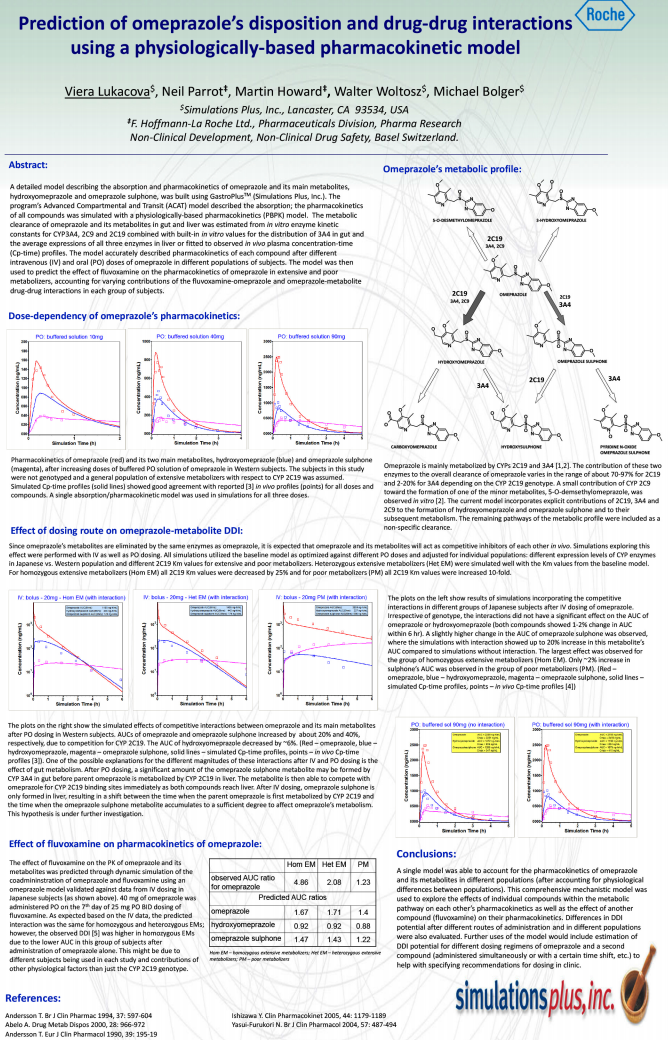
Prediction of Omeprazole’s Disposition and Drug-Drug Interactions Using A Physiologically-Based Pharmacokinetic Model
Download the poster presented at the ADMET Europe 2010 conference on the development of PBPK models and prediction of parent & metabolite DDIs with omeprazole.