
To determine if an IVIVC model can predict PK profiles of varying formulations of a BCS Class 1 drug that is a salt of a weak base.

Case Studies for Practical Food Effect Assessments across BCS/BDDCS Class Compounds using In Silico, In Vitro, and Preclinical In Vivo Data
Practical food effect predictions and assessments were described using in silico, in vitro, and/or in vivo preclinical data to anticipate food effects...
Structure-Activity-Selectivity Relations on the Keto-Pyrrolyl-Difluorophenol Aldose Reductase Inhibitory Scaffold
In recent years it has been observed worldwide a striking increase of cases of diabetes mellitus, which tend to attain an epidemic prevalence.
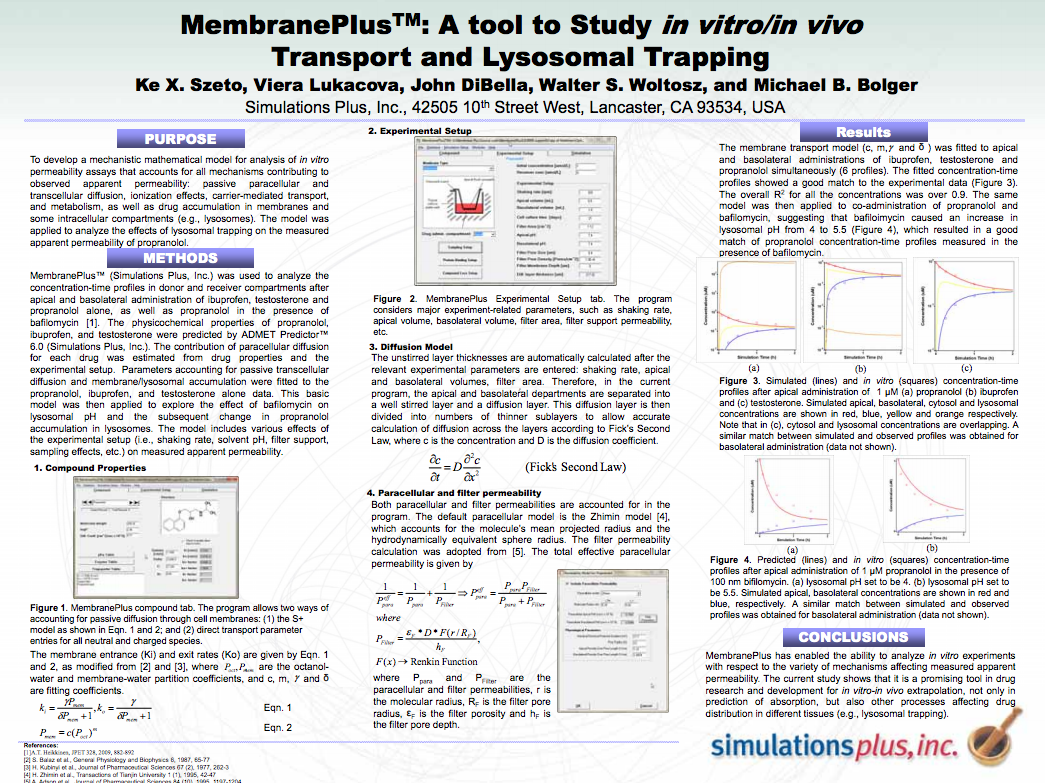
MembranePlus™: A Tool to Study in vitro/in vivo Transport and Lysosomal Trapping
To develop a mechanistic mathematical model for analysis of in vitro permeability assays that accounts for all mechanisms contributing to observed apparent permeability: passive paracellular and…
A Computational Drug-Target Network for Yuanhu Zhitong Prescription
Yuanhu Zhitong prescription (YZP) is a typical and relatively simple traditional Chinese medicine (TCM), widely used in the clinical treatment of headache, gastralgia, and dysmenorrhea.
Virtual Screening and Biological Evaluation of Inhibitors Targeting the XPA-ERCC1 Interaction
Nucleotide excision repair (NER) removes many types of DNA lesions including those induced by UV radiation and platinum-based therapy.
Modeling drug- and chemical-induced hepatotoxicity with systems biology approaches
We provide an overview of computational systems biology approaches as applied to the study of chemical- and drug-induced toxicity.
Simulations Plus Announces Accelerated Quarterly Cash Dividend
Company declares accelerated cash dividend of $0.14 per share
Simulations Plus Reports Preliminary Revenues for First Fiscal Quarter FY2013
Revenues Increase 1.9% for New Record 1st Quarter

Toxicity Webinar
Simulations Plus offers a rapidly growing array of accurate predictive models in ADMET Predictor™, focused on toxicity endpoints deemed important by regulatory agencies.
Modeling and simulation of the effect of proton pump inhibitors on magnesium homeostasis: part I. oral absorption of magnesium
Prolonged use of proton pump inhibitors has reportedly caused rare clinically symptomatic hypomagnesemia.
Application of ED-optimality to screening experiments for analgesic compounds in an experimental model of neuropathic pain
In spite of the evidence regarding high variability in the response to evoked pain, little attention has been paid to its impact on the screening of drugs for inflammatory and neuropathic pain.
Optimised protocol design for the screening of analgesic compounds in neuropathic pain
We have previously shown how screening experiments for neuropathic pain can be optimised taking into account parameter and model uncertainty.
Toxicological considerations of acetylcholinesterase reactivators
The more or less systematic studies on the specific activity of oximes as reactivators of acetylcholinesterase (AChE) inhibited by organophosphorus (OP) compounds...
Integrated Pharmacokinetic-Driven Approach to Screen Candidate Anticancer Drugs for Brain Tumor Chemotherapy
The goal of the study was to develop an effective screening strategy to select new agents for brain tumor chemotherapy from a series of low molecular weight anticancer...
Simulations Plus Reports FY2012 and Fourth Quarter FY2012 Financial Results
Fiscal Year Pharmaceutical Software and Services Up 8.1%, EPS Up 11.1%
Simulations Plus Sets Date for 4th Quarter and Fiscal Year 2012 Earnings Release and Conference Call
Conference Call to be on Monday, November 19, 2012, at 4:15 PM EST
Simulations Plus Announces Next Quarterly Cash Dividend
Company declares cash dividend of $0.05 per share
Dynamic Change of Heme Environment in Soluble Guanylate Cyclase and Complexation of NO-Independent Drug Agents with H-NOX Domain
Soluble guanylate cyclase is a heterodimer receptor that functions in several signal transduction pathways. Conversion of guanosine 5'-triphosphate to...
Nilotinib preclinical pharmacokinetics and practical application toward clinical projections of oral absorption and systemic availability
Nilotinib is a highly potent and selective bcr-abl tyrosine kinase inhibitor used for the treatment of patients who are in the chronic and accelerated phases of...